
How to Make AI Think Like an Expert Copywriter
A four-step setup that turns AI from a soft editor into a working expert who knows the discipline.

Have you ever pasted a draft of your article, sales letter or product into ChatGPT looking for feedback and get back: “Great hook, strong voice, consider tightening the middle.”
Useless. The kind of soft compliment a waiter gives when you order the salmon: “excellent choice”. He’s never had the salmon.
You already knew the hook was decent. You already suspected the middle was soft. The AI confirmed your priors and called it feedback.
The model has NO discipline loaded. It has no worldview to apply to your draft. So it generates the average opinion of the average reader. Polite. Vague. Wrong in a direction you can’t quite name.
This article hands you the fix.
A four-step setup. Free. Works in any AI chat. Two minutes the first time, fifteen seconds every time after that. Once it’s in place, the model stops complimenting moves you already made and starts asking the questions David Ogilvy would ask. Or Eugene Schwartz. Or Robert Cialdini.
If you don’t know those names, keep reading. That’s also fixable.
Context beats prompting
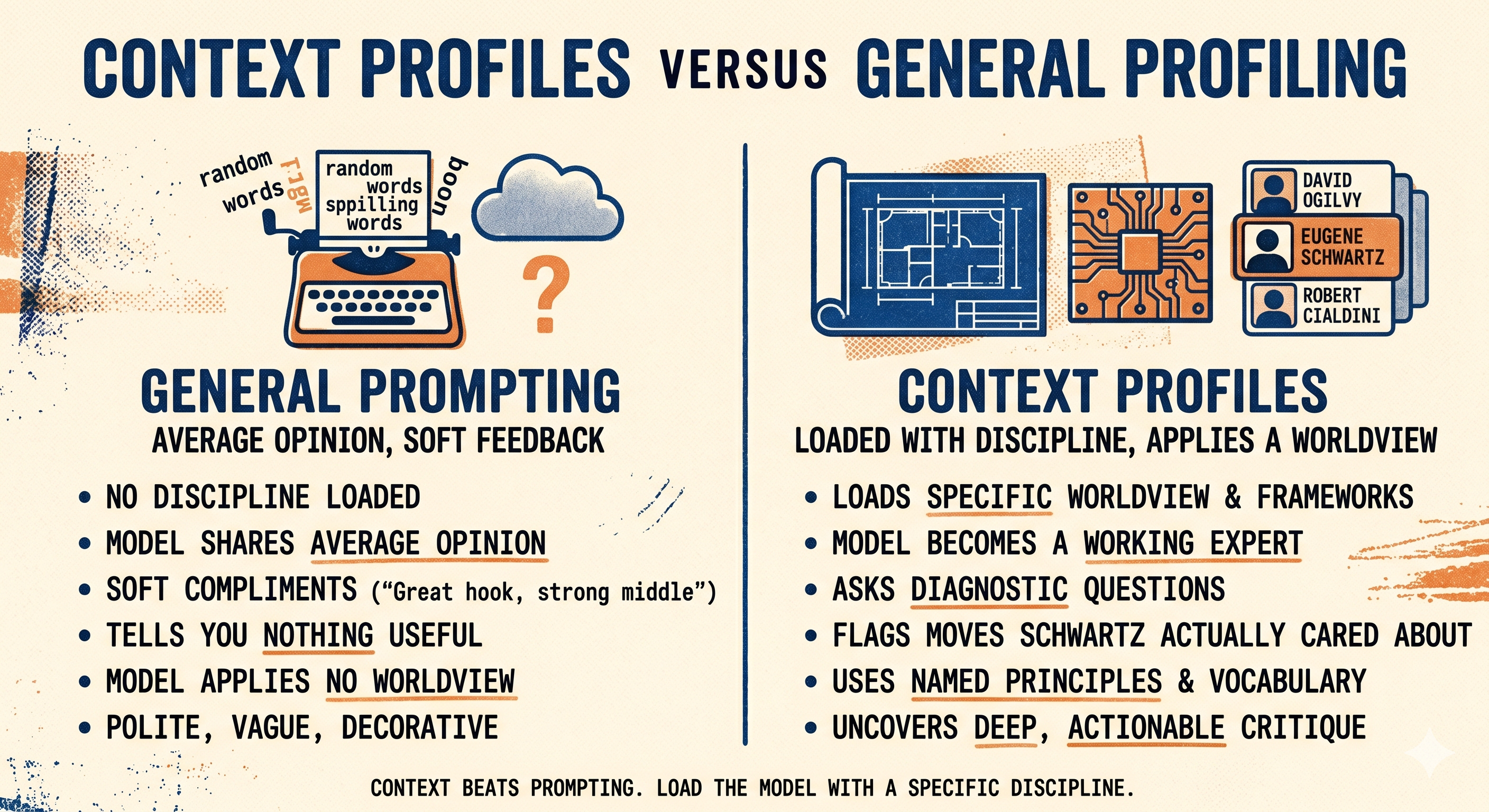
Load the model with a specific discipline before you ask it anything. That single move outperforms every prompt-engineering trick you’ve ever tried.
Once you do, the model has a worldview to apply. It asks the questions Schwartz would ask. Uses Schwartz’s vocabulary. Flags the moves Schwartz actually cared about.
The model still works like a model. The worldview is what changed. It now applies real frameworks to your draft, in the actual language of the discipline. Tested moves. Named principles. Vocabulary that maps to a body of work.
The thing you paste in is called a context profile.
The six things in every real profile
A structured set of instructions you paste into a fresh chat before you ask anything else. Or you save it as a /skill or a project. JSON usually (JSON is nothing to fear, just copy+paste). Markdown sometimes. The format matters less than what’s inside.
A real profile contains six things:
The expert’s central thesis. What they actually believe about the work.
The questions they ask before answering. The diagnostic moves, not the advice.
The operating beliefs. Declarative statements they’d actually write, in their words.
The named frameworks. Real ones, with the components broken out.
The vocabulary. The words they use, the way they use them.
The biases and limitations. The places where their thinking breaks down.
Miss any of those six and what you have is decoration. SKIP it.
Four steps to load a profile in two minutes
Find a profile. Open-source, or grab one from the Expert Profile Library.
Open a fresh chat. Claude or ChatGPT. Both work. If you know me, you know which one I’d pick.
Paste this line, then the full profile. The line is: “Use the following expert profile to evaluate, advise, and respond from the perspective of these published frameworks.” Or turn it into a skill: “Use the following information and make an expert context profile skill.”
Paste your draft. Ask what’s broken. Ask what the expert would change about the headline.
You’ll see the change in the first reply.
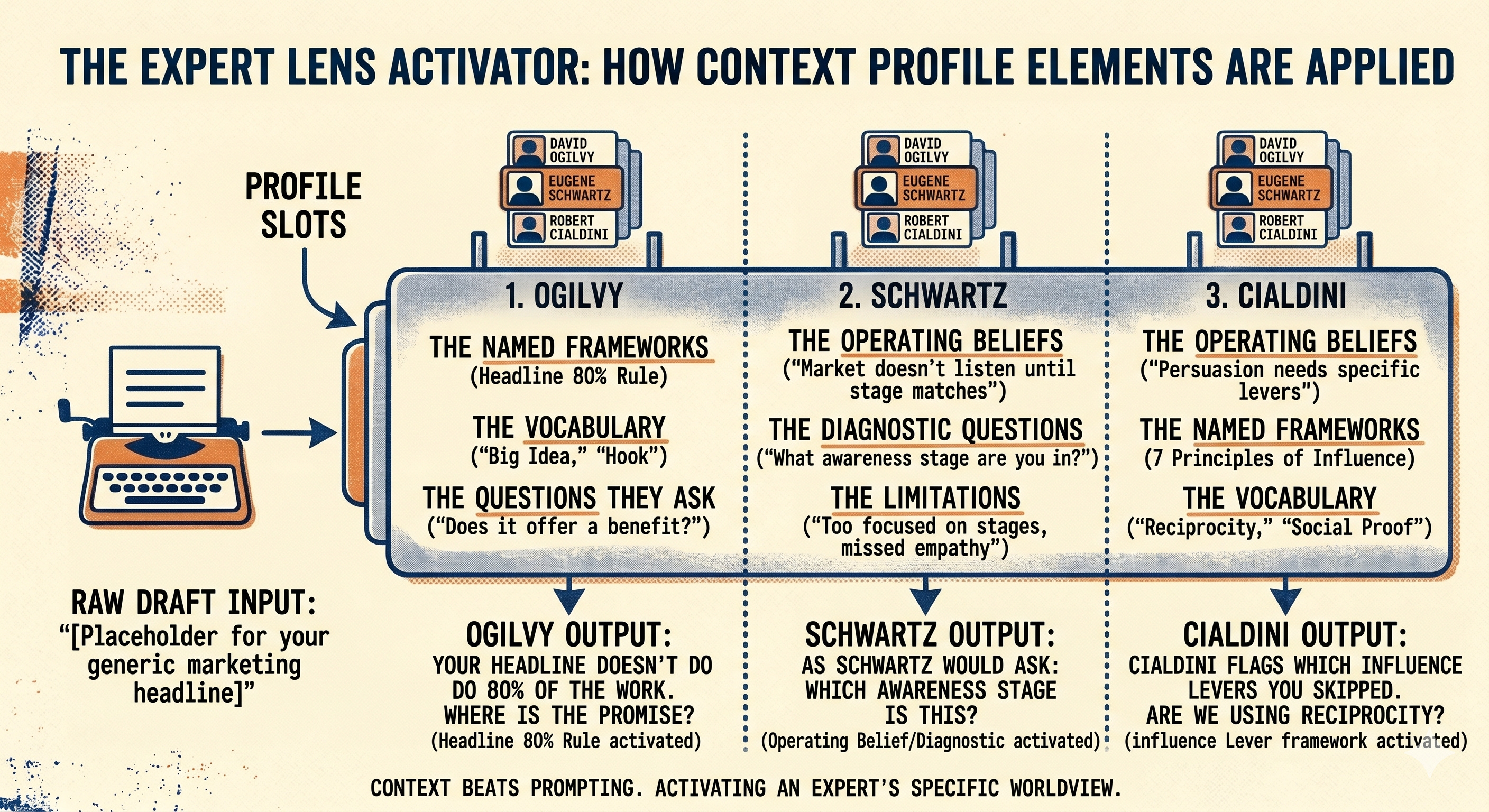
Stack profiles. Run the same draft through several of them in separate chats and watch each one surface a different failure.
Schwartz flags whether you wrote to the right awareness stage.
Cialdini flags which influence levers you skipped.
Ogilvy flags whether your headline does eighty percent of the work like he said it should.
Dunford flags whether your positioning survives five seconds in front of a stranger.
None of them tell you the writing is STRONG.
Fifteen profiles, picked and rebuilt
You can sort through open-source AI repos for real frameworks yourself. Some are gold. Most are AI-generated slop in a clean cover. Sorting one from the other takes weeks. Reading the source. Cross-checking against the original books. Verifying the frameworks behave correctly when you paste them into a chat. Restructuring the survivors into a format that loads cleanly.
I did that work over the past few weeks.
Fifteen profiles. Picked from a much larger pile. Rebuilt into a consistent schema so they all behave the same way when you paste them in.
A few of the names inside:
Eugene Schwartz on awareness stages
David Ogilvy on headlines
Gary Halbert on direct response
Robert Cialdini on the seven principles of influence
Donald Miller on StoryBrand
April Dunford on positioning
Clayton Christensen on Jobs to Be Done
Plus eight more.
The free index page lists all fifteen names with a one-line use case for each. So you know which profile to grab for which problem instead of guessing.
Paid subscribers get the full JSON (simple copy+paste) for every profile, in the schema designed to load cleanly into Claude, ChatGPT, or a custom skill. You also get the operating beliefs broken out so the model knows what the expert actually believes, the vocabulary so it uses the right words, the limitations so you know when the framework will mislead you, and the source citations so you can verify any of it against the original work.
If you write for a living and you’ve ever closed an AI chat thinking “that was fifteen minutes I’ll never get back,” the library is built for you.
Ryan
Thanks man!
these are already saved in my claude folder. Well done.