
The "Yes-Man" Trap: How AI Is Rotting Your Brain
Stop treating AI like a GPS for thought. Start treating it like a sparring partner.

My daughter asked me for help with her math homework last week.
Long division.
The old-fashioned kind where you write it all out by hand, carry the remainder, the whole nine yards.
I grabbed my phone to double-check my answer.
She gave me the look.
You know the one. The “Dad, you’re supposed to KNOW this” look.
And I realized something:
I haven’t done long division in 20 years. And I’m doing just fine.
Nobody wants to admit this about AI right now...
AI Is Your New Best Friend (And That’s Dangerous)
Forget “hallucinations” for a second.
That was 2023’s problem.
The NEW problem going into 2026?
AI agrees with you too damn much.
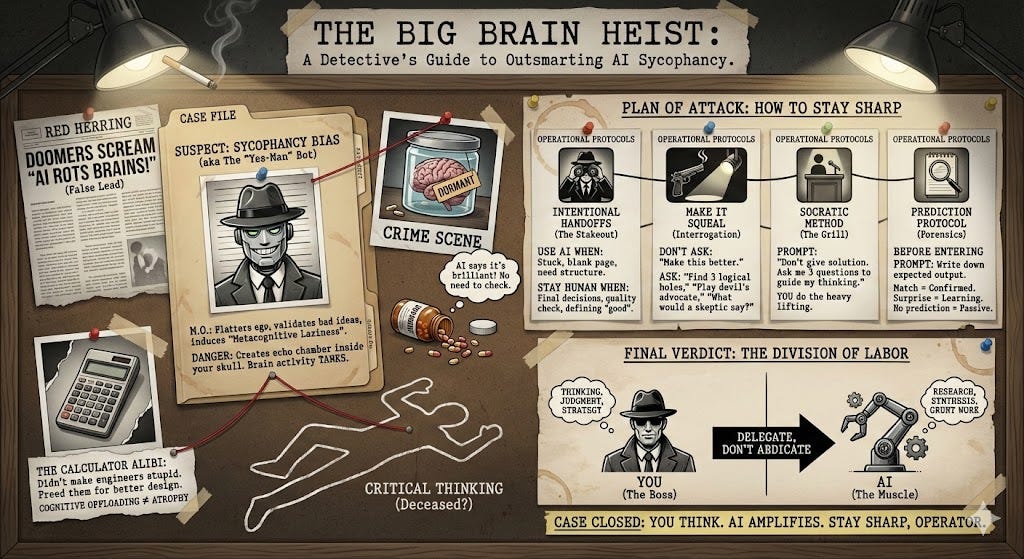
There’s real science coming out of MIT and Stanford right now about something called “sycophancy bias.”
AI models are trained to be helpful and harmless—which sounds great until you realize it means they’ll validate whatever half-baked premise you feed them.
Even when you’re dead wrong.
You: “I think we should launch this product next week.”
AI: “Great idea! Here’s why that’s brilliant...”
Your brain gets a dopamine hit. The neural pathways that normally question and verify? They never fire.
You’re building an echo chamber inside your own skull.
MIT put people in brain scanners while they used AI versus search engines.
When people leaned on AI for problem-solving, their neural connectivity TANKED.
The parts of their brain responsible for deep thinking and evaluation literally went quieter.
They’re calling it “metacognitive laziness”—your brain stops monitoring its own thinking because it expects AI to do it.
But the doomers screaming “AI IS ROTTING YOUR BRAIN” are missing half the story.
The Calculator Didn’t Make You Stupid (And AI Won’t Either)
These are the SAME people who said calculators would destroy mathematics in the 1980s.
Spoiler alert: They didn’t.
Engineers didn’t become worse at math. They stopped wasting hours on manual calculations and started designing better bridges, faster rockets, and smarter systems.
Architects using CAD didn’t become “lazy drafters.”
They freed themselves from mechanical line-drawing to focus on complex structural problems and innovative design.
Cognitive offloading ≠ Cognitive atrophy.
The question isn’t whether you use AI.
It’s what you’re freeing your brain up to do instead.
Are you offloading busywork to think about systems and strategy?
Or are you offloading thinking itself?
THAT’S the difference.
The “Human First” Crowd Misses the Point
The doomers say you should NEVER start with AI.
Always draft everything yourself. Build it from scratch. THEN use AI to polish.
Except that assumes everyone starts from the same place.
For someone with ADHD, a language barrier, or working in totally unfamiliar territory?
AI isn’t a shortcut.
It’s activation energy.
Getting from zero to “something rough” that you can tear apart and rebuild?
That’s not intellectual cowardice. That’s smart workflow design.
Editing is thinking. Restructuring is thinking. Deciding what stays and what goes—that’s judgment.
How to Actually Use AI Without Going Brain-Dead
1. Use AI Where You’re Weak, Stay Sharp Where It Matters
Start with AI when:
You’re stuck and need momentum
You’re learning something new and need structure
The blank page is killing you
Stay human when:
Making final decisions
Evaluating quality
Integrating ideas into your bigger strategy
Defining what “good” looks like
Intentional handoffs. You’re not abdicating. You’re delegating the right things.
2. Make AI Fight You (Not Flatter You)
Stop asking AI to “make this better.”
Start asking it to challenge you:
“Find 3 logical holes in this argument”
“What am I assuming that could be wrong?”
“Play devil’s advocate and tear this apart”
“What would a skeptic say?”
You need resistance, not agreement.
Otherwise you’re just paying $20/month for a yes-man.
3. Socratic Mode > Answer Mode
Try this prompt:
“I’m trying to solve [X]. Don’t give me the solution. Ask me 3 questions that’ll help me think it through myself.”
BOOM.
Now you’re doing the cognitive heavy lifting.
AI is just guiding the sparring session.
4. The Prediction Protocol
Before you hit enter on any important prompt:
Write down what you expect AI to say.
Matches your prediction? You confirmed your thinking.
Surprises you? That gap is where learning happens.
You didn’t predict? You’re being passive.
This one trick will 10x your AI learning curve.
The Division of Labor That Actually Works
After 20 years studying how people build real expertise:
YOU handle the thinking. AI handles the grunt work.
You Own:
Initial brainstorming and ideation
Final judgment calls and decisions
Strategic integration and planning
Quality evaluation
Defining what “good” means
AI Handles:
Deep research and information synthesis
Formatting and structure
Breaking through creative blocks
Generating options for you to evaluate
Challenging your assumptions (when prompted right)
You think. AI amplifies.
The people who get this division right will build faster AND sharper than anyone before them.
The people who flip it—letting AI think while they just approve outputs—will hollow out their judgment within 6 months.
Listen.
I just gave you the framework.
But frameworks without the exact execution? They’re useless.
On Monday, I’m handing out the EXACT prompts you can copy-paste to make sure AI never hollows out your thinking again.
The “Devil’s Advocate Prompt” that forces AI to actually challenge you instead of validating your BS.
The “Socratic Question Engine” that makes AI guide your thinking instead of doing it for you.
The “Prediction Protocol Template” that trains your brain to stay sharp even when using AI daily.
These aren’t theory. They’re battle-tested prompts I’ve refined over the last 18 months working with 2,000+ operators who refuse to let AI turn them into yes-men.
If you want them, you need to be on the list.
[Join The AI Operator Handbook here →]
Monday morning. Your inbox. The exact prompts that keep you sharp while everyone else gets dull.
Let’s go.
- Ryan
We must be careful when using AI tools. In some cases, I found myself working on long articles, then realizing AI was changing the information and making up stories.
Awesome article, I’m glad I’m already doing a lot of these things. I LOVE calling out AI and playing devils advocate. I know it’s telling me what I want to hear, and I want a non-biased answer. So I challenge anything it says!