
How I Wrote a Substack Article that Earned $1180
and how you can too.

One article. $1,180 and 73 new subscribers.
Not a launch. A Substack post:
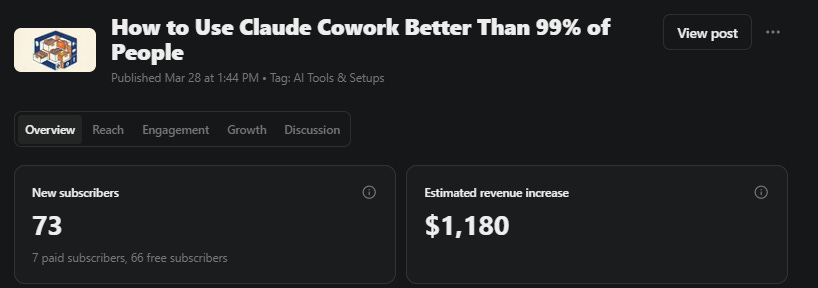
I have over a dozen messages sitting in my inbox right now from people asking how “AI can write better articles”. Most of them think AI will do all the work if they just find the right prompt.
For that article, yes, AI helped write it. But there’s a division of labor in there that people get backwards. Get it wrong and the post is invisible. Get it right and it converts while you sleep.
Here’s exactly what I did. Seven steps. What I handled, what AI handled, and why the ORDER matters more than any prompt you’ve ever seen.
Step 1: Let AI Find the Topic
I run a content intelligence pipeline that monitors what’s moving in AI circles and flags angles worth building. The Cowork setup idea came from that. No blank page staring. The machine surfaced it, I decided it had legs, and we moved.
Most people spend 45 minutes trying to will something original into existence. Build the pipeline instead. Let AI do the prospecting.
My previous article walks through part of this process. My morning brief system drops later this week.
Step 2: You Decide If It’s Worth Building
AI has no taste. It doesn’t know your audience, your positioning, or which topics you’re actually credible on.
That filter is yours. It takes 30 seconds. Don’t hand it to the machine.
Step 3: AI Checks Your Blind Spot
After writing almost 50 articles on Substack, I’ve learned something the hard way. If I skip this step, I write for people who already understand the AI deeply. I lose 80% of my audience in the first paragraph.
Before I touch structure, I run the topic through a prompt that pressure-tests the angle against a non-technical reader. What does someone who doesn’t know the jargon actually need to understand for this to be useful? Where does the article assume too much? Where does it condescend?
That prompt has saved me from three disasters in the last two months alone. It’s not glamorous. It catches the blind spot you can’t see because you’re too close to the topic.
Step 4: You Lay Out the Structure
This is the step AI CANNOT do for you.
Not because it won’t try. It’ll produce something that looks like structure. The problem is it doesn’t understand what each section is supposed to DO to the reader at each stage. It assembles sections. It doesn’t build toward a conclusion.
I learned how to structure long-form content inside our community’s live writing cohort. The step-by-step guide format I used for that article wasn’t a guess. I picked it because I understood what that format does to a reader psychologically, section by section. That knowledge lives in my head. A prompt can’t replicate it.
You lay the structure out. Every section, in order, with a one-line note on what it needs to accomplish for the reader before they move on.
Step 5: You Talk, AI Cleans
I write voice-to-text. Raw, fast, no editing. I’m not worried about sentences. I’m getting the thinking out in the right order.
AI cleans it up in my voice. Not generic. I have a voice file built over months that tells Claude exactly how I sound, what I avoid, and what I never say. The output doesn’t need a rewrite. One read.
This step takes 20 minutes for a full article. It used to take me two hours.
Step 6: Humans Review It
Two coaches looked at that draft before it went live. One caught a CTA that wasn’t placed right. One cut a section I was too attached to. Both were correct. The headline structure was hashed out, this is the first impression, this can make or break virality.
AI gives you feedback. A person with actual stakes in your outcome gives you something different. They’ll say the thing you didn’t want to hear, which is usually the thing that makes the article work.
This step is not optional if you want the article to convert.
Step 7: AI Handles the Rest
Images. SEO slug. Tags. Meta description. Twenty minutes total.
Where the $1,180 Actually Came From
Steps 1, 3, 5, and 7 are AI. Steps 2, 4, and 6 are human. That division isn’t accidental.
AI executes. You decide, structure, and get reviewed. The moment you hand steps 2, 4, or 6 to the machine, the output looks “meh” and converts nothing. That’s where every content workflow I’ve seen breaks down. People automate the wrong steps and wonder why the numbers are flat.
The $1,180 didn’t come from a better prompt. It came from knowing which steps belong to you, and being good at them.
The Skill You Can’t Prompt Your Way Into
Publish Profit Sprint is our community’s live 20-day cohort. It starts today.
20 days inside a private community with creators who’ve built real publications on Substack. You’re building your actual content, getting real-time feedback on what’s working and what isn’t, from people who’ve already been through it.
Step 4 is a skill. Step 6 is a skill. The cohort is where you build them. AI handles the rest once you have them.
See you inside,
Ryan
I look forward to learning in the course the long-form structure I can feed to AI.
👏👏👏