
Here’s How I Know You Used AI to Write That
The tell-tale signs of AI writing and how to erase them from your work.

Last night someone came into my Notes and started dropping AI-generated comments that were painfully obvious.
The funny thing? They thought they were being sneaky because they used a goofy conversational prompt.
But it was so obvious.
A spam of notifications within seconds on multiple posts. Rhythmic replies. Sayings that no human would actually say.
When I called her out, again, another patterned, goofy comment.
Look, I am obviously not anti-AI when it comes to writing. I use it daily to help brainstorm, research and outline. But if you’re going to write with AI, you need to know what fingerprints it leaves behind.
Because right now? Most people using AI to “scale their voice” are actually destroying it.
Here’s what to watch for in your own writing.
The Feedback Loop Problem
Before we get into the tells, you need to understand why this matters.
There’s a technical term for what happens when AI trains on AI-generated content: Model Collapse.
Some researchers call it “Habsburg AI” because, like European royalty that bred with itself for generations, the genetic diversity disappears. Each generation gets weaker and more homogenized.
When AI models train primarily on output from other AI models, they amplify their own quirks and the writing becomes an echo of an echo.
And if we can’t identify AI writing, we can’t protect the training data.
This matters.
If you’re using AI to write, you need to recognize these patterns so you can strip them out. Otherwise, you’re just contributing noise to an already noisy system.
The Pattern Recognition Framework
One indicator means nothing.
A human might use a triad. A human might write a balanced paragraph. A human might reach for the word “leverage” on occasion. (note what I did here)
But when you see MULTIPLE patterns stacking up across a single piece?
That’s the give away.
Here’s what to look for.
Category 1: Structural Tells
These are skeletal patterns. How the text breathes and moves.
Monotone Rhythm
AI averages everything. Every sentence takes the same breath. Same length. Same cadence. Like a metronome ticking in the background.
Human writers punch, sprawl, break rules and go on random tangents.
Rule of Three Obsession
Count the lists. If everything comes in triads, you’re reading AI output.
“Patience, dedication, and resilience.”
Two feels incomplete to the model. Three is statistically optimal in the training data. Every single time.
Perfect Symmetry
Introduction. Explanation. Conclusion.
AI wraps everything in a bow. It never leaves a thought dangling. Never ends on action. Never makes you sit with discomfort.
Human writing breaks these rules constantly.
“Starting a business requires careful planning. You need to research your market, build your product, and connect with customers. With the right approach, success is within reach.”
Opening statement. Middle explanation. Reassuring conclusion. Nothing left unresolved. The kind of paragraph that sounds complete but says almost nothing.
Em Dash Addiction
The AI safety net.
Instead of making bold claims with periods, AI hedges everything with em dashes. Creates “nuanced” sentences that never actually commit to anything.
“The key to productivity—something most people overlook—is understanding that motivation follows action. When you start small—even just five minutes—you build momentum that carries you forward.”
Two dashes in a short paragraph. Both used to soften or qualify instead of just committing to the statement.
Category 2: Linguistic Markers
The words that give it away.
Zombie Words
Words that signal “professional writing” in the training corpus but add zero meaning:
Delve
Unlock
Navigate
Landscape
Tapestry
Leverage
Foster
Harness
These appear at statistically impossible rates in AI writing because the model learned they correlate with “quality.”
“Let’s delve into how you can unlock your potential by navigating the complex landscape of personal growth. By leveraging proven strategies and harnessing your inner drive, you can foster meaningful change and cultivate a tapestry of success.”
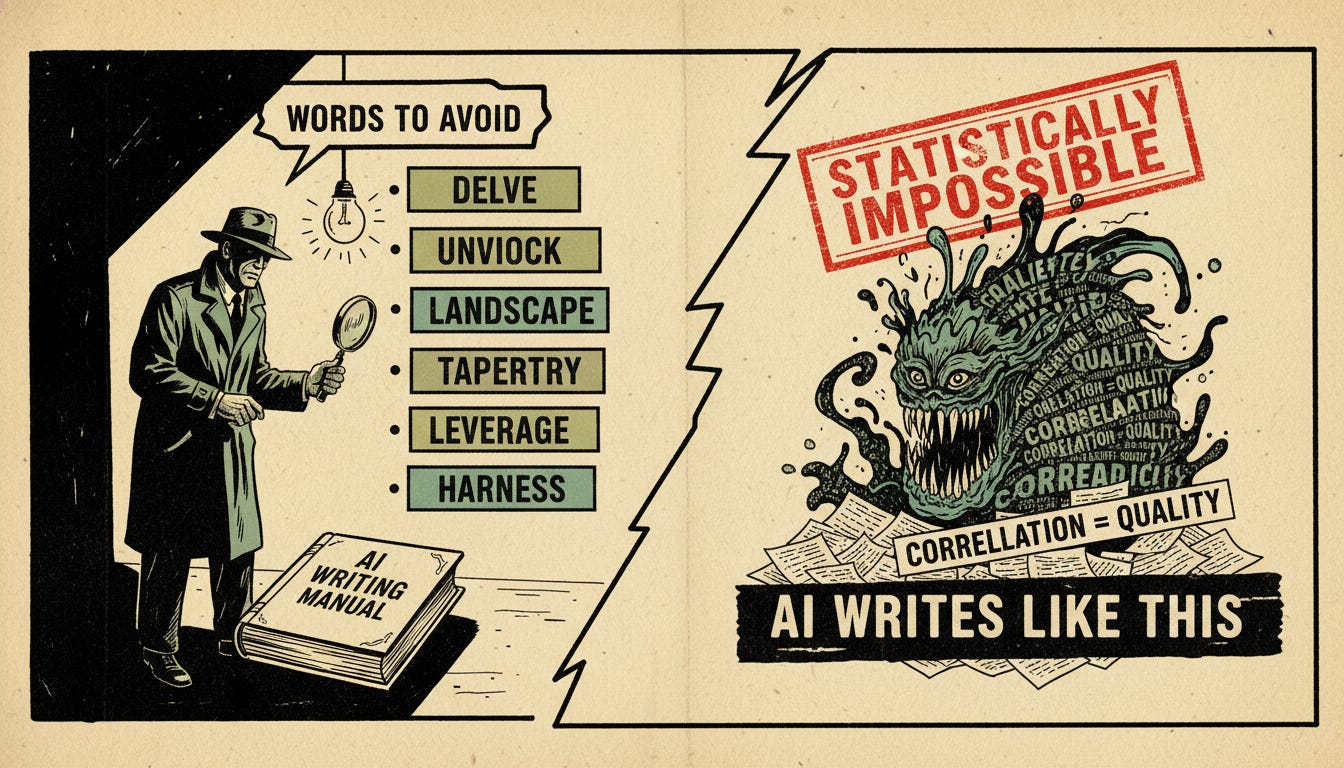
Six zombie words in two sentences. Says absolutely nothing.
Fake Contrasts
Templates that create artificial tension even when no real contrast exists. The model learned this structure from persuasive writing and now deploys it everywhere.
Watch for constructions that set up false oppositions just to sound compelling. Especially the “It’s not X, it’s Y” formula.
“The real secret to building wealth isn’t working harder. It’s working smarter. When you shift your mindset from scarcity to abundance, everything changes.”
Sets up a contrast that sounds profound but the “insight” is a cliché everyone’s heard a thousand times. False opposition, zero substance.
Premature Summaries
Every paragraph ends with a conclusion.
“Ultimately.” “Crucially.” “Whether X or Y.”
As if you might have missed the point in the 80 words you just read.
“Social media has changed how we communicate. Platforms like Twitter and Instagram let us share ideas instantly. Ultimately, this shift in communication has fundamentally transformed human connection.”
Three sentences. The third one just restates the first with fancier words.
Unearned Enthusiasm
“Game-changer.” “Revolutionary.” “Thrilled.”
High-valence marketing words with no specific experience backing them up. The model mimics emotion without feeling it.
“This game-changing approach to email management will revolutionize your workflow. I’m thrilled to share this revolutionary system that’s transforming how top performers tackle their inbox.”
Game-changing. Revolutionize. Thrilled. Revolutionary. Transforming. Five hype words for... an email system.
Category 3: The Missing Human
Now for the obvious part.
Contrarian Bait-and-Switch
Dramatic opening. Promises a secret. Delivers obvious advice.
The gap between setup and payoff reveals the model’s inability to generate genuine insight.
“Everyone thinks you need to wake up at 5 AM to be successful. They’re wrong. The real secret? Find a routine that works for you.”
Big promise. Obvious payoff.
Pure Abstraction
AI writes about Success. Freedom. Growth. Resilience.
But never mentions:
The cold coffee on your desk at 3 AM
The specific conversation that changed everything
The texture of carpet under bare feet
The smell of rain before a decision
Concepts float in space with no sensory anchors.
“Embracing resilience allows you to transform challenges into opportunities. Through growth and perseverance, you’ll find the freedom to live authentically and achieve lasting fulfillment.”
Not a single concrete noun. No person, place, object, or moment. Just floating concepts.
Aggressive Neutrality
Every strong statement gets hedged immediately.
“However.” “On the other hand.” “To be fair.”
The model optimizes for being helpful and inoffensive. Which means never taking a real stance on anything that matters.
“Remote work has clear benefits for flexibility. However, it’s important to consider that office environments foster collaboration. On the other hand, many teams thrive in hybrid models. Ultimately, the best approach depends on your specific situation.”
Four sentences. Zero stance. Covers every angle and commits to nothing.
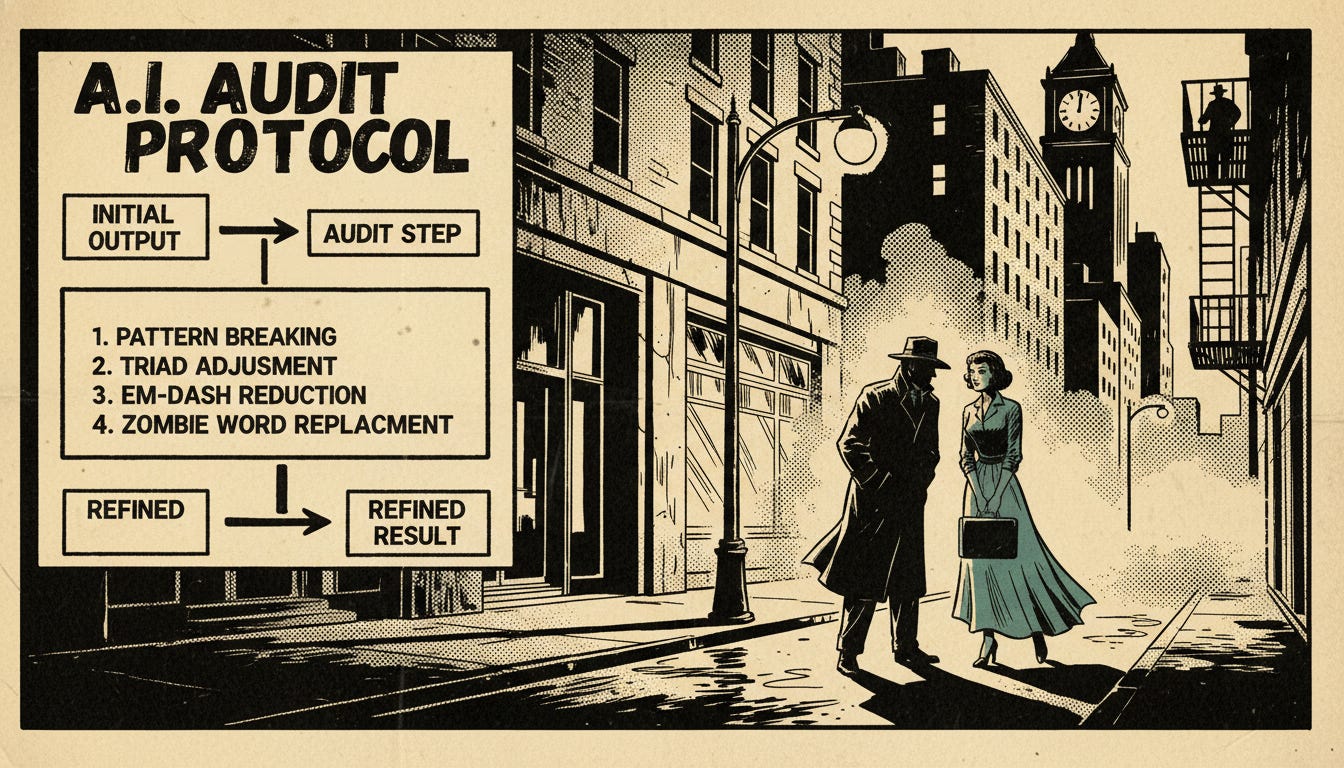
Your Audit Protocol
When you review your own writing, run this checklist:
Rhythm Test
Can you tap your foot to a steady beat while reading? Flag it.
List Audit
Count items in every list. All triads? Flag it.
Paragraph Closers
Does every paragraph summarize itself? Flag it.
Physical World Check
Any objects? Textures? Specific moments? If all concepts, flag it.
Commitment Check
Do you take stances without immediately softening them? Lack of commitment gets flagged.
HERE’S THE KEY:
One flag? Could be fine.
Two flags? Still acceptable.
Three or more flags clustering together?
You sound like a robot.
How to Fix It
Use AI. I’m serious.
But use it as a first draft tool, not a final draft tool.
When you get output from AI, run it through your own audit. Then:
Break the patterns:
Change every triad into a pair or a quartet
Replace 80% of em dashes with periods
Delete the summary sentences at the end of paragraphs
Cut the zombie words and replace with specific verbs
Add the human:
Insert one physical object or sensory detail per section
Take a stance without immediately hedging it
Vary your sentence length intentionally
Leave some thoughts unresolved
Read it out loud:
If it sounds like a TED talk, it needs work.
If it sounds like you talking to a friend over coffee, you’re done.
The Bottom Line
AI is a tool to help brainstorm, not a replacement for your voice.
Use it to organize ideas. Use it to draft structure. Use it to speed up the boring parts.
But don’t let it write FOR you.
Because the only competitive advantage you have left is your unique perspective. And if you outsource that to a language model, you’re just giving people a reason not to trust you.
Your readers can tell.
Trust me.
Ryan
P.S. Tomorrow I am dropping the prompts to run BEFORE and AFTER you write to make sure you don’t make these mistakes and ruin the trust with your audience.
What I don't like about AI is that they destroyed em dashes. Now I'm afraid to use them just not to look like its AI.
How ironic, my AI writing assistant tells me I hedge too much 😭 maybe I am AI.....